

Home/ Blog/ Why is my AC running but not cooling?
Why is my AC running but not cooling?
Start with the easy checks: thermostat set to cool and below room temperature, a clean filter, the outdoor unit running and the breaker on. If those are fine, the usual causes are a frozen indoor coil, a dirty outdoor coil, a failed capacitor or contactor, a refrigerant leak or a clogged drain that has tripped a safety switch. No-cool and weak-cooling calls are among the service visits we see most often. Some checks you can do yourself. Refrigerant and electrical problems need a technician.
How this call usually shows up
Homeowners describe the same problem in different words: the air conditioner stopped blowing cold air, a brand-name split unit is not working or a split duct system is running but the house stays warm. In our service history those visits are booked as no-cool or poor-cool jobs far more often than most other service types. The checks below cover what usually turns out to be wrong.
Check these first (5 minutes)
- Thermostat: set to Cool, not Fan or Auto fan only and a few degrees below room temperature. Replace batteries if it has them.
- Filter: a clogged filter starves the system of air and can freeze the coil. Replace it if it looks gray or dusty.
- Breakers and switches: both the indoor unit and the outdoor unit have power. Check the outdoor disconnect too.
- Outdoor unit: is the fan spinning and can you hear the compressor running?
- Registers: supply vents open and returns not blocked by furniture.
Frozen indoor coil
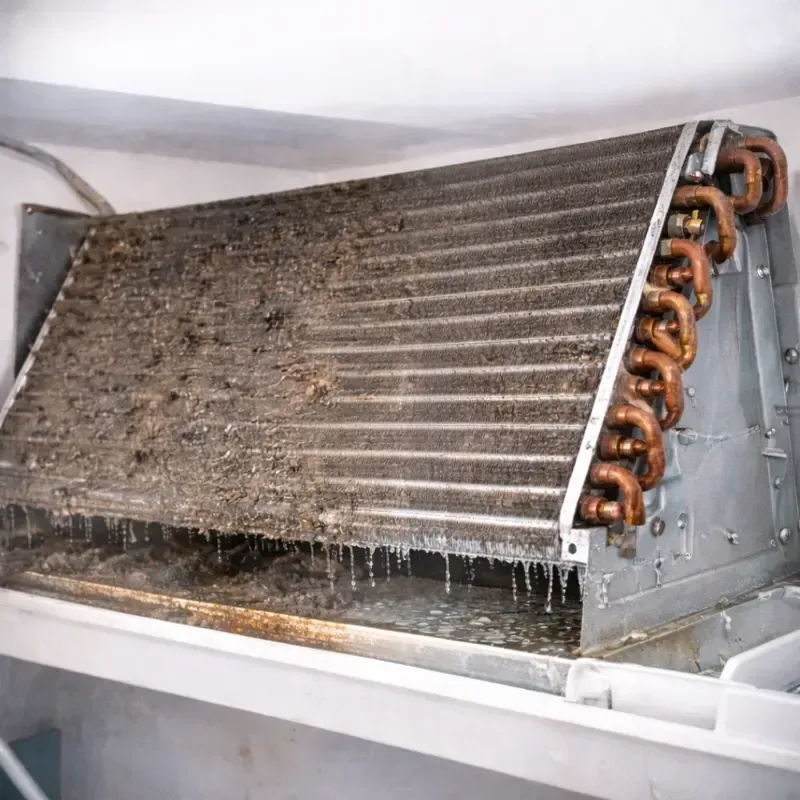
If you see ice on the copper refrigerant line near the indoor unit, or the air coming out is weak, the coil may be frozen. Causes include a dirty filter, a blower problem or low refrigerant. Turn the cooling off and run the fan only for a few hours to thaw it. If it freezes again after you replace the filter, call for service. Running a frozen system can damage the compressor.
Dirty outdoor coil
The outdoor coil gets rid of the heat taken out of your house. When it is clogged with grass, cottonwood, dirt or salt, the system cannot shed heat and cooling falls off, especially on hot afternoons. With the power off, a gentle garden hose rinse helps. A professional cleaning goes further. Homes near the water should read what salt air does to coastal AC units.
Capacitor and contactor (common outdoor failures)
Many "it hums but will not start" and "fan spins but nothing cools" calls end at the outdoor electrical parts. A run or dual-run capacitor helps the compressor and fan motor start and keep running. A contactor is the switch that sends power when the thermostat calls for cooling. A hard-start kit is sometimes added when a compressor struggles to start. These are routine truck-stock repairs when the rest of the system is healthy. They are not DIY: capacitors can hold a charge after the power is off. Do not push the fan blades with a stick to help them start.
On the visit the technician confirms the outdoor unit has the right voltage, tests the capacitor when needed, checks the contactor points and coil and verifies the outdoor fan and compressor both run after the part is replaced. If the same capacitor fails again soon, that can point to a harder problem such as a failing compressor or a shorted motor, which is a different conversation from a one-time part swap. See repair or replace when the finding is more than a single component.
Refrigerant leak
Air conditioners do not use up refrigerant. If the charge is low, there is a leak. Signs include weak cooling, ice on the lines, hissing or bubbling sounds and long run times. A good repair finds the leak rather than just adding refrigerant. Refrigerant work requires EPA Section 608 certification. Be wary of anyone who wants to top off a system every year without looking for the leak. On older systems, the refrigerant type and the location of the leak affect whether repair makes sense; see repair or replace.
Clogged condensate drain
Your AC removes water from the air and drains it away. If the drain clogs, water backs up and a float switch may shut the system off, or the indoor unit leaks. Look for water around the air handler or a full condensate pan. Clearing the drain is often simple, but repeated clogs point to algae or a drain sloped the wrong way.
Ductwork problems
If the system makes cold air at the unit but some rooms stay warm, the problem may be ducts that are disconnected, crushed or leaking into an attic. Upstairs rooms in Cape-style homes are a classic example. Sometimes the right answer is duct repair; sometimes it is a ductless mini-split for the problem room.
The system is simply too small or too old
An undersized system can run all day on the hottest days and never catch up. An old system with worn components may lose capacity over time. These are honest limits, not quick fixes. A technician can tell you whether the issue is repairable or whether replacement is the realistic answer.
What not to do
- Do not keep running the system if the lines are iced up.
- Do not reset breakers repeatedly if they keep tripping.
- Do not add refrigerant yourself; it is illegal without certification and can damage the system.
- Do not pressure wash the outdoor coil.
When to call
Call if the basics check out and the house is still warm, if you see ice, if breakers trip or if water is leaking. A diagnostic visit finds the cause and gives you repair options in writing before work starts. Our urgent help page covers what to do right now. See AC repair for the repair path. We take these calls from Bethpage, Seaford, Deer Park, Massapequa and across our service area. Request a diagnostic.
Frequently asked questions
Why is my AC blowing air but not cold air?
Common causes are a dirty filter, a frozen indoor coil, a dirty outdoor coil, a failed capacitor or contactor, a fan motor problem or a refrigerant leak. Check the thermostat, filter and breakers first.
Can I add refrigerant to my AC myself?
No. Handling refrigerant requires EPA Section 608 certification and low refrigerant means there is a leak that should be found and fixed.
Should I turn off my AC if it is frozen?
Yes. Turn cooling off and run the fan only to thaw the coil. If it refreezes after a filter change, call for service.
What is an AC capacitor and why does it fail?
The capacitor helps the compressor and outdoor fan start and run. Heat, age and electrical stress wear it out. A humming outdoor unit that will not start is a common symptom. Leave testing and replacement to a technician because the part can hold a charge.
Sources
- US EPA, Section 608 of the Clean Air Act (refrigerant handling certification)
- ENERGY STAR, HVAC maintenance checklist
Related
More from the blog
Find us
ADM Mechanical, Farmingdale
640 Fulton St #9A
Farmingdale, NY 11735
Read Our Google Reviews Leave a Review
Nassau/Suffolk: 516-610-0233 NYC: 718-570-7587Get a technician on it.
Request service online or call the office. We confirm every request by phone.